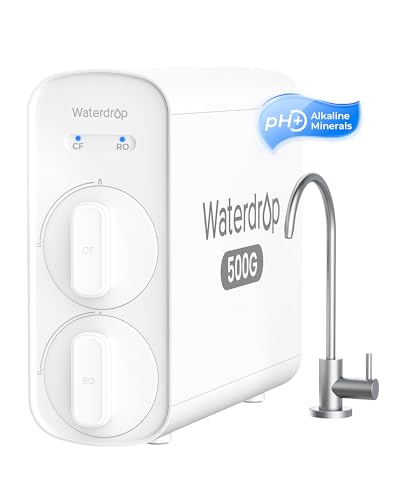
Reverse osmosis systems
A multi-stage system that forces water through a semi-permeable membrane, removing the overwhelming majority of dissolved substances. The most thorough domestic filtration available.
Reverse osmosis pushes water through a membrane whose pores are small enough to block dissolved salts, metals, nitrates, fluoride and most everything else, leaving water that is close to pure. Typical domestic systems run four to six stages: sediment pre-filter, carbon pre-filter, the membrane itself, then post-filters and often a remineralisation cartridge.
It produces the best-tasting and cleanest water of anything here, by a distance. It is also the most involved: a storage tank under the sink, a drain connection for the reject water, a dedicated tap, and a ratio of waste to product water that on older systems can be three or four to one.
In the UK, RO is usually overkill for mains water, which is already treated to a high standard. It comes into its own for specific concerns — nitrates in some rural supplies, private boreholes, aquariums, coffee enthusiasts who want to build their water from scratch — or where someone simply wants the most thorough option and is content with the trade-offs.
Best for
- The most thorough drinking water filtration available domestically
- Private supplies and boreholes
- Specific concerns like nitrates or fluoride
- Aquariums and specialist coffee
- Households that dislike their tap water and have tried everything else
Standard in coffee shops, laboratories and food production, usually with larger membranes and pressure-boosted feeds.
Pros and cons
Pros
- Removes far more than any other domestic filter
- Excellent taste
- Effective against dissolved contaminants that carbon does not touch
- Well-established, mature technology
Cons
- Wastes water — check the reject ratio before buying
- Slow, which is why there is a storage tank
- Takes up substantial cupboard space
- Removes beneficial minerals too, hence remineralisation stages
- Most stages plus a membrane means more cartridges to replace
Can you install it yourself?
Get a plumber for this one
Skill level: Advanced · Time: about 3 hours
The filter side is manageable, but the drain connection is where this stops being a DIY job. It has to be made so that waste water cannot siphon back into the drinking supply, which means the correct air gap and a properly fitted waste connector. Get that wrong and you have plumbed a contamination route into your own drinking water.
Tools you will need
- Drill and hole cutter
- Waste saddle or drain connector
- Adjustable spanner
- Push-fit tubing cutter
Call a plumber if
- The waste line needs connecting to the sink drain
- A new tap hole is needed
- You are not confident about backflow protection on the drain connection
Maintenance
Pre- and post-filters every six to twelve months. The membrane itself every two to three years. Sanitise the tank at membrane changes.
Replacement interval: roughly every 6 months, though volume matters more than time. More on cartridge intervals.
What installation costs
£250–£500 indicative UK labour
Labour only. Higher where a tap hole must be drilled or the drain connection is awkward.