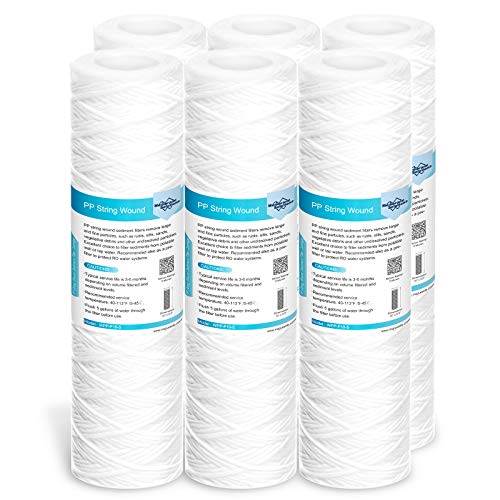
Replacement cartridges
The consumable at the heart of every filtration system, and the thing most likely to be forgotten until the water tastes wrong again.
Whatever system you have, the cartridge is the part that actually does the work and the part you will buy again and again. Over ten years the cartridges will cost considerably more than the system did, which is worth knowing before you choose a system with proprietary consumables.
The good news is that most under-sink and whole-house systems use standard sizes. A 10-inch or 20-inch cartridge in either 2.5-inch or 4.5-inch diameter — usually written as 10 x 2.5 or 20 x 4.5 — will fit any housing built to that standard regardless of who made it. That means real competition and sensible prices.
The exceptions are the systems designed to lock you in: proprietary bayonet fittings, encapsulated cartridges, and appliance filters. There the manufacturer sets the price. It is a legitimate design choice, but it belongs in the buying decision rather than being discovered a year later.
Best for
- Anyone with an existing filtration system
- Keeping a system actually working rather than nominally installed
- Bulk buying standard sizes to cut the running cost
Commercial systems usually run on a service contract that includes cartridges.
Pros and cons
Pros
- Standard sizes are competitively priced and widely available
- Multipacks reduce the cost per change substantially
- Swapping stages lets you retune a system to a new problem
Cons
- Easy to forget until performance has already dropped
- Proprietary fittings remove all price competition
- Micron ratings and media types are not always clearly labelled
- Very cheap unbranded cartridges vary in what they actually contain
Can you install it yourself?
Yes, this is a realistic DIY job
Skill level: Easy · Time: about 15 minutes
Isolate the supply, release the pressure, unscrew the housing, swap the cartridge, grease the O-ring, reassemble, flush through until the water runs clear.
Tools you will need
- Housing spanner
- Bucket
- Food-safe silicone grease
Call a plumber if
- The housing is seized, which happens when nobody greased the O-ring last time
Maintenance
Follow the interval for the cartridge type — sediment three to six months, carbon six to twelve, RO membrane two to three years.
Replacement interval: roughly every 6 months, though volume matters more than time. More on cartridge intervals.
What installation costs
£60–£150 indicative UK labour
Labour only, if you have someone do it. Most people do it themselves.